
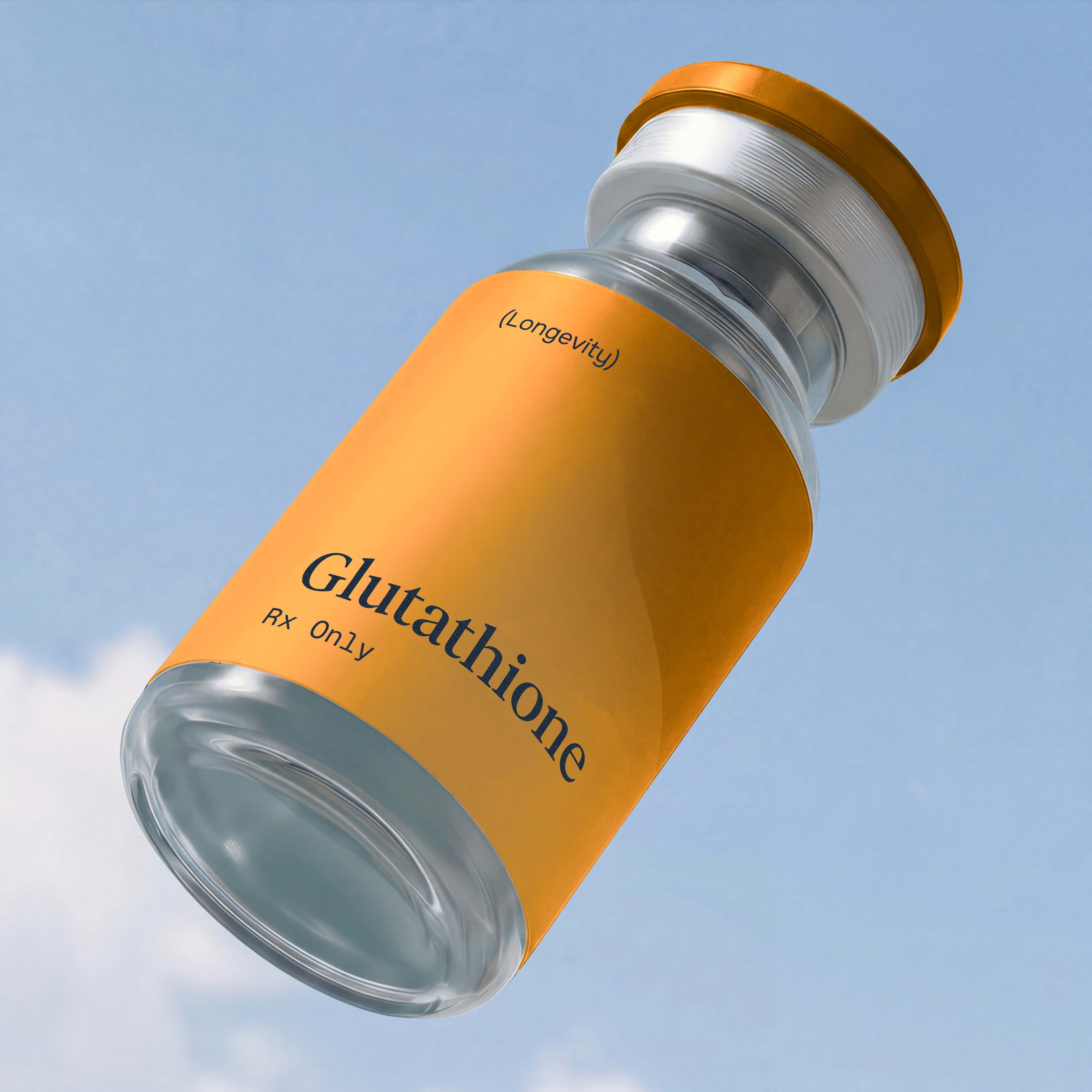
Injectable glutathione at a glance
Injectable glutathione delivers the body's own antioxidant by needle instead of by mouth. Your cells make glutathione on their own, and a glutathione injection is meant to support your levels under clinician guidance rather than to promise a specific result. In a clinician-guided program such as Harbor's, a board-certified physician reviews your health history before anything ships.
No glutathione product is FDA approved in the United States, the CDC noted in September 2026, so every shot on offer is a compounded medication. Seven questions are worth asking before you start, and the table gives the short answer to each. For how a program runs day to day, read what glutathione therapy involves.
| Question | Short answer | Where it comes from |
|---|---|---|
| What it is & why it is injected | An antioxidant your cells build from three amino acids. A single oral dose did not raise blood levels in one study | Giustarini 2023, Witschi 1992 |
| What the evidence says | Blood levels rise after an IV dose. Wellness outcomes are not established | Aebi 1991, Hauser 2009 |
| Muscle or under the skin | Both routes are used. The at-home route is under the skin | CDC 2026, MedlinePlus |
| Dose & schedule | No FDA-labeled dose exists. Your clinician sets both | CDC 2026 |
| Cost | Ask what the price includes before you compare numbers | The program page |
| Where it is compounded | At a compounding pharmacy, on a prescription | FDA, CDC 2026 |
| What it will not do | It is not approved to lighten skin or treat a disease, and no program can guarantee a result | CDC 2026, program terms |
Short answers to the seven questions, each sourced in its own section below. Compounded glutathione is not FDA approved.
Questions to ask about glutathione injections
These seven questions cover what glutathione injections are, what they can and cannot be expected to do, and how a prescription gets filled. Bring them to the clinician who reviews your intake. Each answer below names its source, and each lists what to ask in your own words.
Two federal notices shape several of the answers. On August 27, 2026, the FDA reminded compounders not to use dietary supplement grade glutathione for injectables, after reports of at least 30 patients who had adverse events following intravenous glutathione. In September 2026, the CDC reported more than 25 people sick in at least four states after glutathione given by vein, under the skin or into a muscle. The CDC said that, so far, every injection linked to those illnesses was made with glutathione ingredients intended for dietary supplements.
Both notices are about how a product was made, which is why question six asks about the pharmacy. The FDA rules on drug compounding set the conditions a compounding pharmacy has to meet, including a valid prescription for an individual patient under section 503A of federal law.
What glutathione is & why it is injected
The body's own antioxidant
The plain answer to "what is glutathione" is a tripeptide: three amino acids, glutamate, cysteine and glycine, joined into one small molecule that your cells make and use as an antioxidant. It is injected because glutathione taken by mouth is largely broken down by enzymes in the gut and liver before it reaches the blood.
Where it wins
What it costs you
Start here if the molecule is new to you
What the evidence says about glutathione injection benefits
Clear biology, thin outcome data
Injected glutathione raises blood levels, briefly. What that does for a healthy adult is not established, so most claimed glutathione injection benefits run ahead of the research. The two studies below are small and used an IV line, one in healthy volunteers to measure blood levels and one in people with Parkinson's disease.
Where it wins
What it costs you
Promising biology, unproven outcomes
Whether the shot goes in muscle or under the skin
Two routes for the same molecule
Both routes are in use. A glutathione im injection goes into a muscle, and a glutathione subcutaneous injection goes into the fatty tissue just under the skin. No FDA label names either one as standard, because no glutathione product is FDA approved.
Where it wins
What it costs you
Know your route before the vial arrives
What dose & schedule your clinician suggests
Set per patient, not by a label
There is no standard glutathione injection dosage per week. No glutathione product is FDA approved, so no label sets a dose or a schedule, and the amounts used in published studies were research doses for specific groups. Your clinician sets both for you.
Where it wins
What it costs you
The dose on your prescription is the one to follow
What a glutathione injection costs
Ask what the price includes
A glutathione injection price means little until you know what it covers. The glutathione program lists one flat monthly price that includes the medication, clinician care and check-ins, with no insurance required.
Where it wins
What it costs you
Compare what is included, not only the number
Where the glutathione is compounded
A compounding pharmacy, on a prescription
Injectable glutathione is a compounded medication, typically prepared by a licensed compounding facility, so how the pharmacy made it matters. Compounded drugs are not FDA approved, which means the FDA does not verify their safety, effectiveness or quality before they are marketed.
Where it wins
What it costs you
Ask before the first vial ships
What injectable glutathione will not do
Limits worth hearing early
Injectable glutathione is not approved to treat, cure or prevent any condition, and that includes lightening skin. A program supports your levels under clinician guidance rather than promising a specific result.
Where it wins
What it costs you
Support under a clinician, not a promise
How to start injectable glutathione with Harbor
Starting takes an online quiz, a physician review and, if you are approved, a delivery to your door. Harbor's glutathione injections are prescription-only, and a board-certified physician reviews your health history and goals before deciding whether treatment is appropriate for you. The medication is compounded and is not FDA approved.
- Take the online quiz, which covers your goals and your health history.
- A board-certified physician reviews your intake. Say if you are pregnant or breastfeeding, and list every medication and supplement you take, so the review has the full picture.
- If glutathione is appropriate, the medication ships free with estimated delivery within a few days, and you inject it under the skin at home.
- At regular check-ins, your clinician reviews how you are responding and adjusts the program as needed.
Your injectable glutathione dosage comes out of that review, not from a chart online. The clinician sets the amount and the schedule and can adjust both as you go.
Questions are welcome before you commit. In an October 17, 2026 Trustpilot review, member Karen Grau wrote, "I had questions after doing the intake form, but before making my payment." She described getting answers in the support chat, which also made sure her information reached the medical team.
Checked before anything ships
A board-certified physician confirms glutathione is appropriate before anything ships. If it is not the right fit, it is not prescribed. For any question after you start, message your Harbor clinician through the patient portal.
The seven questions above are the ones a physician review is there to answer. If glutathione support makes sense for you, the 90-second quiz starts that review.
Medical disclaimer
This article is for general education and is not medical advice. It is not a substitute for evaluation, diagnosis, or treatment by a licensed clinician. Talk with a qualified clinician about your individual situation.
Compounded medications
Harbor is a technology platform. Medical evaluations are conducted by independent, licensed healthcare providers who determine whether treatment is appropriate. Providers may prescribe FDA-approved or compounded medications based on clinical judgment and patient needs. Compounded medications are not FDA approved and are not reviewed by the FDA for safety or effectiveness.
Frequently asked questions
No. The CDC stated in September 2026 that there are no FDA-approved glutathione products in the United States, and that covers injections sold for wellness or for skin. Injectable glutathione is compounded, and the FDA does not verify the safety, effectiveness or quality of compounded drugs before they are marketed. That is why "is glutathione safe" has no blanket answer. It turns on your own health history, which a clinician reviews, and on how the pharmacy prepared it.
There is no standard schedule, because no FDA label exists for glutathione. Published studies used their own research schedules, such as three IV doses a week for 4 weeks in one Parkinson's trial. In a clinician-guided program, the injection is given at home on a schedule your clinician sets for you, and that schedule is reviewed at check-ins.
No. An IV drip sends glutathione through a line placed in a vein, while a shot goes under the skin or into a muscle. After an IV dose in 10 volunteers, plasma levels peaked and then fell with a half-life of about 14 minutes (Aebi, 1991). Harbor's program is a subcutaneous injection you give yourself at home, and it does not include IV drips. The two routines are compared in shots vs IV glutathione drips .
Sources
- U.S. Food and Drug Administration. FDA reminds compounders not to use dietary supplement grade glutathione for injectables. August 27, 2026.
- Centers for Disease Control and Prevention. Adverse events linked to injectable glutathione compounded with dietary supplement grade ingredient: current situation. September 2026.
- U.S. Food and Drug Administration. Human drug compounding laws.
- U.S. Food and Drug Administration. Compounding and the FDA: questions and answers.
- Giustarini D, et al. How to increase cellular glutathione. Antioxidants (Basel). 2023;12(5):1094.
- Witschi A, et al. The systemic availability of oral glutathione. Eur J Clin Pharmacol. 1992;43(6):667-669.
- Richie JP Jr, et al. Randomized controlled trial of oral glutathione supplementation on body stores of glutathione. Eur J Nutr. 2015;54(2):251-263.
- Aebi S, Assereto R, Lauterburg BH. High-dose intravenous glutathione in man. Eur J Clin Invest. 1991;21(1):103-110.
- Hauser RA, et al. Randomized, double-blind, pilot evaluation of intravenous glutathione in Parkinson's disease. Mov Disord. 2009;24(7):979-983.
- MedlinePlus Medical Encyclopedia. Subcutaneous (SQ) injections. U.S. National Library of Medicine.
Keep reading
All 199 articles →- Longevity
NAD+ vs NADH: What Each Form Does & Which One Injections Use
NAD+ and NADH are one coenzyme in two states. NAD+ is the empty carrier, NADH the loaded one. Here is what each does, what the evidence shows and why prescription injections use NAD+.
By Harbor Health Team
- Longevity
Sermorelin vs NAD+ Shots, Two Longevity Injections Compared
One is a peptide that signals a gland. The other is a coenzyme your cells already use. Both are prescription injections with a physician's review. Here is what each has shown, and where a clinician fits.
By Harbor Health Team
- Longevity
Sermorelin vs BPC-157: What Each Peptide Does & Which One Is Prescribed
Sermorelin is a prescription peptide with an FDA approval history. BPC‑157 has never been approved, and FDA and HHS both acted on it in 2026. Here is what each does and which one is prescribed.
By Harbor Health Team

