

NAD+ vs NADH verdict
NADH vs NAD+ is less a contest than a cycle. Both are the same coenzyme in two states: NAD+ accepts electrons as your cells break down food and becomes NADH, and NADH passes those electrons to the mitochondria to make ATP, which turns it back into NAD+ (Nat Rev Mol Cell Biol, 2021).
For a prescription injection, NAD+ is the form that counts. Sirtuins, PARPs and NADases such as CD38 use NAD+ itself as a substrate and turn it over, so cells must keep making more, and NAD+ is the form a 2021 review describes declining gradually in tissues and cells with age. Harbor's NAD+ program aims to support your NAD+ levels under the guidance of a licensed clinician who determines whether it is appropriate for you.
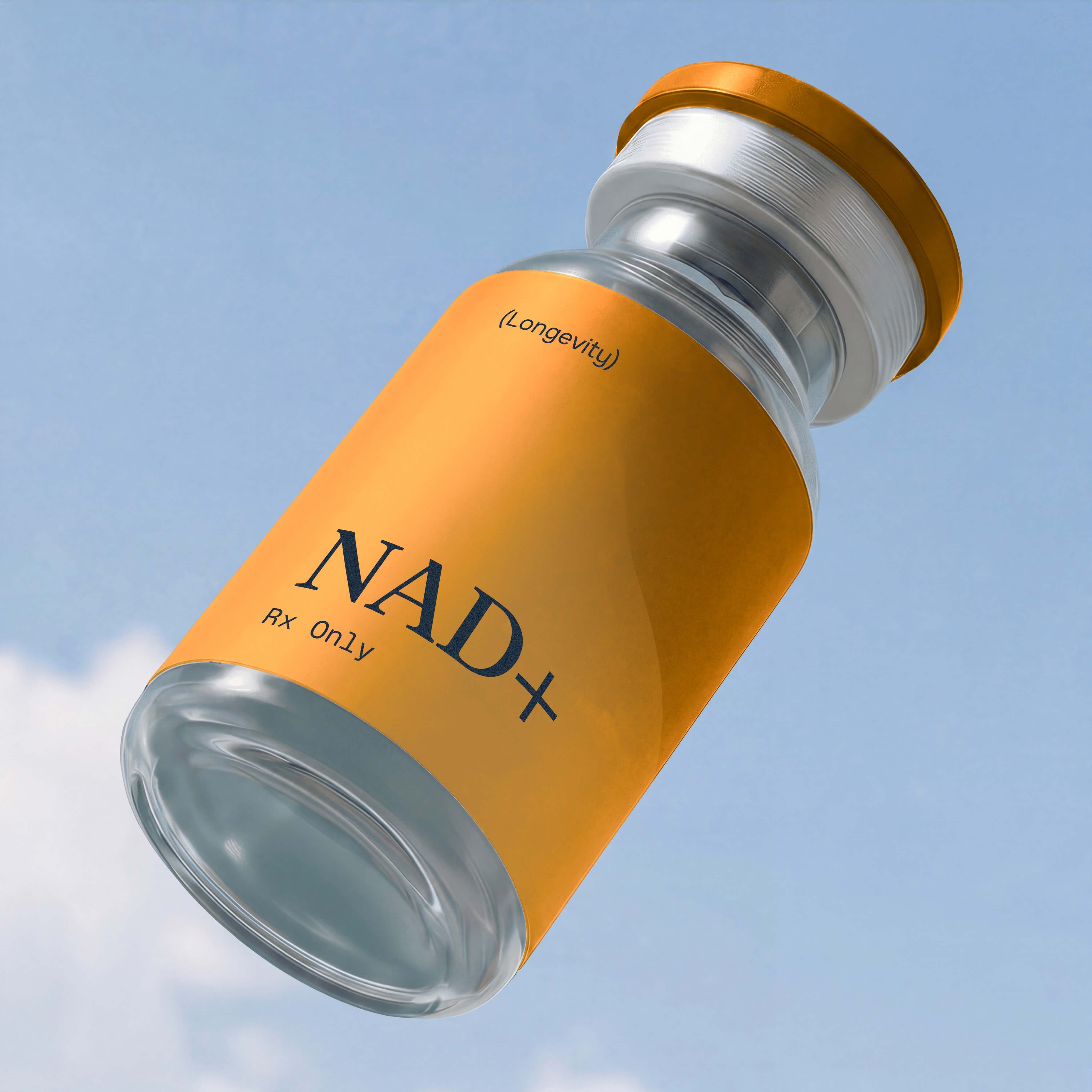
NADH mostly reaches people as an oral supplement, bought without a prescription. Prescription NAD+ is a compounded injection that is not FDA approved, and it ships only after a board-certified physician reviews your health history and goals.
NAD+ vs NADH side by side
Seen side by side, NAD+ vs NADH is one molecule doing two jobs. The NAD vs NADH split matters little inside a cell, where the two trade places constantly, and a great deal at the point of purchase, where you buy one form or the other.
What each form does in your cells
NAD+ is the hydride acceptor in glycolysis, fatty acid oxidation and other pathways that break down fuel. Once it accepts a hydride ion it becomes NADH, and in the mitochondria NADH is oxidized by complex I of the electron transport chain, which is how its electrons end up forming ATP (Nat Rev Mol Cell Biol, 2021).
NAD+ has a second job that NADH does not share. Three classes of enzymes, the NADases such as CD38, the sirtuins and the PARPs, use NAD+ as a substrate and leave nicotinamide behind, and they take part in processes that include DNA repair and immune cell function. For the chemistry in more depth, see this NAD coenzyme overview.
Which one carries more energy
NADH does, in the narrow chemical sense. It holds the electrons that the mitochondria turn into ATP, while NAD+ is the empty carrier waiting for its next load.
That does not make NADH the form cells run short of. In a classic 1967 study of rat liver, free NAD+ outnumbered free NADH by about 725 to 1 in the cytoplasm of well-fed rats and by about 8 to 1 inside the mitochondria (Biochem J, 1967). Cells keep most of the free pool ready to accept electrons. Rat data, and a ratio rather than a dose.
None of this chemistry shows that swallowing or injecting either form changes how energetic a person feels. That question needs human trials.
Supplements vs injections
NADH is sold mainly as an oral dietary supplement. Under federal law, FDA does not have the authority to approve dietary supplements before they are marketed (FDA). No prescription is needed, so no clinician has to review your health history before you buy.
Injectable NAD+ is a prescription product. A search of Drugs@FDA on November 19, 2026 returned no approved NAD+ or NADH product, so NAD+ prescribed today is compounded and is not FDA approved. FDA's list of bulk substances nominated for 503A compounding, updated May 14, 2026, places both NAD and the reduced form, NADH, in Category 1, the group still under evaluation (FDA 503A categories).
Neither form is simply the stable one. A 2024 laboratory study notes that NADH breaks down by acid-catalyzed reactions and NAD+ by base-catalyzed ones, and that buffer and temperature both change the rate (Molecules, 2024).
Evidence & cost
Human trials of NADH are small. In a 1999 crossover pilot, 26 patients with chronic fatigue syndrome took 10 mg of oral NADH or a placebo for 4 weeks each, and 8 of 26 (31%) responded favorably to NADH against 2 of 26 (8%) to placebo (Ann Allergy Asthma Immunol, 1999). Those are study doses in a specific population, not a guide.
Two later trials paired NADH with CoQ10, so neither isolates NADH. In 73 patients over 8 weeks, fatigue scores improved more than with placebo (Antioxid Redox Signal, 2015). In 207 women, fatigue scores moved in parallel in both groups (Nutrients, 2021).
Injected NAD+ has a different gap. A 2026 systematic review found no eligible outcomes trials of intravenous or intramuscular NAD+ for anti-aging or wellness, while oral precursors raised NAD-related markers with mixed functional results (Ageing Res Rev, 2026). A 2019 pilot that infused NAD+ into a vein for 6 hours saw no change in plasma NAD+ until after the second hour (Front Aging Neurosci, 2019). Promising chemistry, modest data, for both forms.
Cost works differently as well. An NADH supplement is priced by the bottle, and that price covers the capsules alone. The NAD+ program is one flat monthly price, from $99/mo, with medication, clinician care and check-ins included, no insurance required and HSA or FSA eligible.
| Attribute | NAD+ injections | NADH supplements |
|---|---|---|
| Chemical state | Oxidized, ready to accept electrons | Reduced, carrying electrons |
| Main job | Accepts electrons, and is used up by sirtuins, PARPs and CD38 | Delivers electrons to the mitochondria to make ATP |
| Usual product | Compounded prescription injection | Oral dietary supplement |
| FDA review | Compounded, not FDA approved | None before a supplement is sold |
| Who sets the dose | A licensed clinician, after reviewing your history A physician reviews your health history and goals first | The bottle's label |
| What the price covers | From $99 /mo, with medication, clinician care & check-ins Care is included in one flat price | The capsules only |
| Clinician access | 24/7 for medical questions Licensed clinicians answer medical questions | None built in |
Scroll the table sideways to see both columns →
Who should choose NAD+ or NADH
The NADH vs NAD+ choice usually follows two things: what you hope to support, and how much clinical oversight you want around it.
An NADH supplement may suit you when:
- You want an over-the-counter product and accept that no clinician reviews it first
- You are comfortable with small trials and mixed results
- You will tell your own clinician about every supplement you take
NAD+ injections may suit you when:
- You want a medically guided approach to energy and healthy aging
- You are interested in supporting your body at the cellular level
- You want clinician support and monitoring, not just a prescription
- You are comfortable with a simple at-home injection routine
Weighing NAD+ vs NMN is a separate choice, between an injection and an oral precursor your body converts into NAD+. The 2026 review found that oral NR and NMN consistently raised NAD-related markers in blood or cells, with effects on function that were mixed and often null.
Clinician access is part of the prescription route. In an August 20, 2026 Trustpilot review, Harbor member Leah Nadel wrote that she was "happy that a medical provider is available to answer any questions about my medical health that might interfere with the medication."
List every supplement on your intake
A board-certified physician reviews your health history and goals before NAD+ is prescribed, so name every supplement you take, NADH and NMN included. For any question once you start, message your Harbor clinician.
Bottom line on NAD+ injections vs NADH supplements
NAD+ injections and an NADH supplement start from the same coenzyme and lead to different kinds of care. Harbor NAD+ injections are a prescription program built for adults seeking clinician-guided support for energy, recovery and healthy aging, and a board-certified physician confirms it is appropriate before anything ships.
Your clinician sets the schedule for a self-administered injection under the skin at home and reviews how you are responding. An NADH supplement is a capsule you choose and dose on your own. Compounded NAD+ is not FDA approved, and the program aims to support your NAD+ levels rather than promising a specific result.
If NAD+ looks like the better fit, the online quiz takes about 90 seconds and is the first step toward a physician review. If a clinician does not approve treatment, your payment is refunded in full.
Medical disclaimer
This article is for general education and is not medical advice. It is not a substitute for evaluation, diagnosis, or treatment by a licensed clinician. Talk with a qualified clinician about your individual situation.
Compounded medications
Harbor is a technology platform. Medical evaluations are conducted by independent, licensed healthcare providers who determine whether treatment is appropriate. Compounded medications are not FDA approved and are not reviewed by the FDA for safety or effectiveness.
Frequently asked questions
NADH holds more chemical energy, because it carries the electrons that the mitochondria use to make ATP, while NAD+ is the empty carrier ( Nat Rev Mol Cell Biol, 2021 ). Cells need both and keep most of their free pool as NAD+, ready to accept electrons. Holding energy in a molecule is not the same as feeling more energetic after taking it. The NADH trials cited here were small and limited to people with chronic fatigue syndrome, so they say little about how either form feels in healthy adults.
No, though they are one molecule in two states. If you are wondering what is NADH, it is the reduced form of nicotinamide adenine dinucleotide, made when NAD+ accepts a hydride ion during the breakdown of food. NAD+ is the oxidized form, and it is the one sirtuins, PARPs and CD38 use up. As products they differ too: NADH is mostly an oral supplement, and NAD+ a compounded prescription injection that is not FDA approved.
No approved label made the choice, since Drugs@FDA lists no product of either form, and FDA keeps both under evaluation for 503A compounding. The case for NAD+ is biological: it is the form that sirtuins, PARPs and CD38 consume and the form described declining in tissues with age, and cells convert it to NADH and back as needed. Whether compounded NAD+, which is not FDA approved, suits you is decided by the licensed clinician who reviews your intake.
Sources
- Covarrubias AJ, et al. NAD+ metabolism and its roles in cellular processes during ageing. Nat Rev Mol Cell Biol. 2021;22(2):119-141.
- NIH Office of Dietary Supplements. Niacin fact sheet for health professionals (updated November 18, 2022).
- Williamson DH, Lund P, Krebs HA. The redox state of free nicotinamide-adenine dinucleotide in the cytoplasm and mitochondria of rat liver. Biochem J. 1967;103(2):514-27.
- Wolfe KD, et al. Long-term stability of nicotinamide cofactors in common aqueous buffers. Molecules. 2024;29(22):5453.
- Forsyth LM, et al. Therapeutic effects of oral NADH on the symptoms of patients with chronic fatigue syndrome. Ann Allergy Asthma Immunol. 1999;82(2):185-91.
- Castro-Marrero J, et al. Does oral coenzyme Q10 plus NADH supplementation improve fatigue and biochemical parameters in chronic fatigue syndrome? Antioxid Redox Signal. 2015;22(8):679-85.
- Castro-Marrero J, et al. Effect of dietary coenzyme Q10 plus NADH supplementation on fatigue perception and health-related quality of life in individuals with ME/CFS. Nutrients. 2021;13(8):2658.
- Gallagher C, Emmanuel OO. NAD+ supplementation for anti-aging and wellness: a PRISMA-guided systematic review of preclinical and clinical evidence. Ageing Res Rev. 2026;116:103057.
- Grant R, et al. A pilot study investigating changes in the human plasma and urine NAD+ metabolome during a 6 hour intravenous infusion of NAD. Front Aging Neurosci. 2019;11:257.
- U.S. Food and Drug Administration. Questions and answers on dietary supplements (content current as of August 27, 2026).
- U.S. Food and Drug Administration. Drugs@FDA: FDA-approved drugs (searched November 19, 2026).
- U.S. Food and Drug Administration. Bulk drug substances nominated for use in compounding under section 503A (updated May 14, 2026).
- U.S. Food and Drug Administration. Compounding and the FDA: questions and answers (content current as of September 16, 2025).
Keep reading
All 199 articles →- Longevity
Sermorelin vs NAD+ Shots, Two Longevity Injections Compared
One is a peptide that signals a gland. The other is a coenzyme your cells already use. Both are prescription injections with a physician's review. Here is what each has shown, and where a clinician fits.
By Harbor Health Team
- Longevity
Sermorelin vs BPC-157: What Each Peptide Does & Which One Is Prescribed
Sermorelin is a prescription peptide with an FDA approval history. BPC‑157 has never been approved, and FDA and HHS both acted on it in 2026. Here is what each does and which one is prescribed.
By Harbor Health Team
- Longevity
8 Sermorelin Benefits & What the Evidence Actually Supports
Sermorelin benefits are claimed widely and tested rarely. Here are eight, each graded by the human study behind it, who was in that study and where the evidence stops.
By Harbor Health Team
