
Sermorelin peptide benefits at a glance
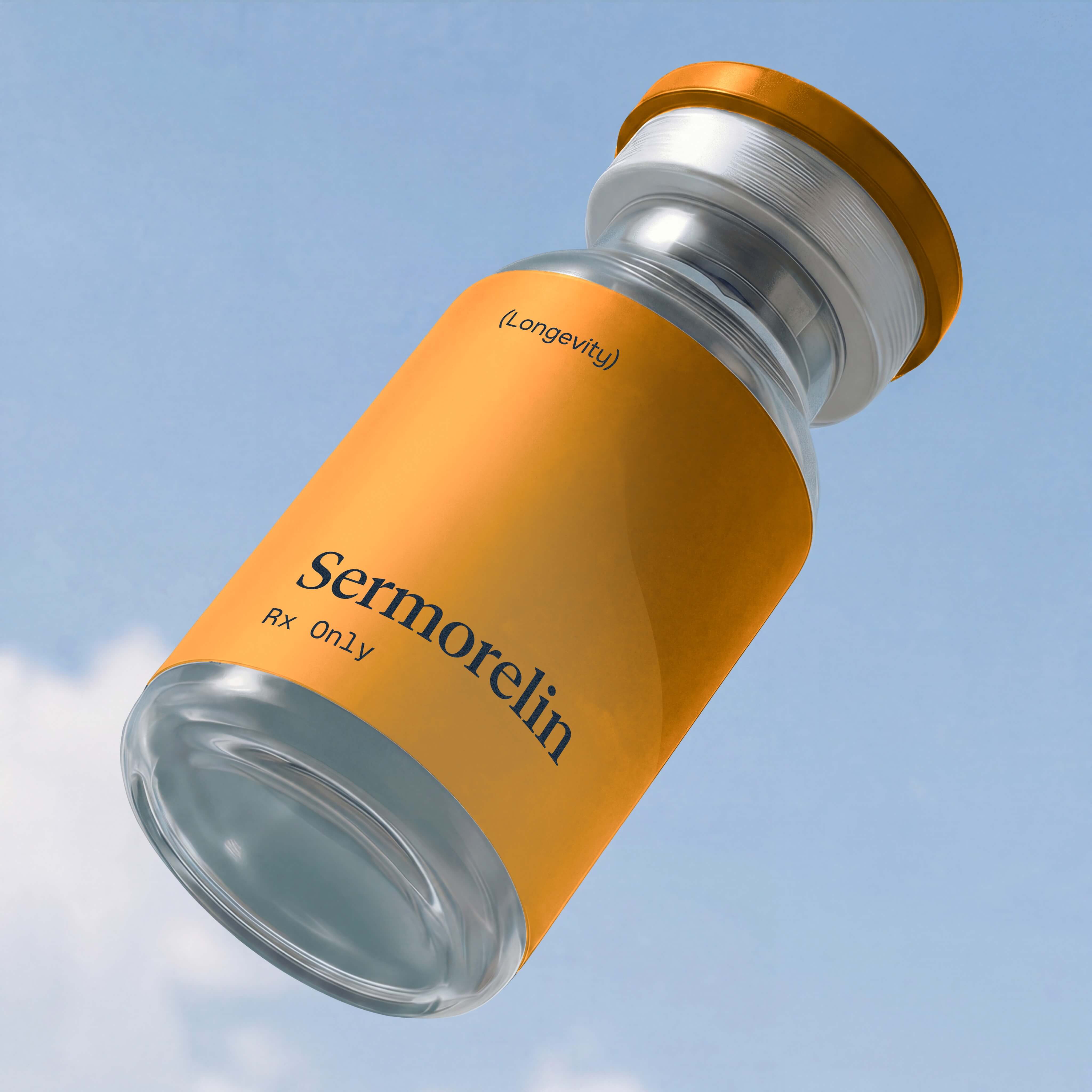
Sermorelin is a prescription peptide that signals your pituitary gland to release its own growth hormone. That signal is the best-documented effect, measured in human studies since the early 1990s. Most other sermorelin peptide benefits you read about rest on a handful of small studies in older adults, or on its past use in children with growth hormone deficiency.
Each benefit below is graded A for an effect shown repeatedly in human studies, B for a small or single human study, and C for mixed, null or untested results. Harbor's sermorelin program is built on the grade A part. A licensed clinician decides whether it fits you, and the program supports your own growth hormone release rather than promising a specific result.
| Benefit | Best human study | Who was studied | Grade |
|---|---|---|---|
| Growth hormone release | Corpas 1992, twice-daily injections for 14 days | 10 healthy men, mean age 68 | A |
| Deeper sleep | Steiger 1992, IV GHRH for one night. Khorram 1997, nightly for 16 weeks | 7 men. 19 adults aged 55 to 71 | C |
| Body composition and lean mass | Khorram 1997, nightly for 16 weeks | 19 adults aged 55 to 71 | B |
| Recovery after exercise | Vittone 1997, nightly for 6 weeks | 11 men aged 64 to 76 | C |
| Energy and wellbeing | Khorram 1997, questionnaires | 9 men and 10 women | B for wellbeing, energy untested |
| Skin and bone markers | Khorram 1997, calipers and bone scans | 19 adults aged 55 to 71 | B for skin, C for bone |
| A gentler signal than HGH | Mechanism papers, 1997 and 2006 | No head-to-head adult trial cited | C |
| Clinician-guided dosing | No current FDA label dose | Schedules varied by study | Not graded |
Khorram 1997 tested a close analog of sermorelin with one amino acid changed. Full citations are in the references.
Sermorelin benefits the research supports
These sermorelin benefits run roughly from the strongest evidence to the weakest. Every study used injections, so these are sermorelin injection benefits, not results for pills or sprays. Averages describe small groups, and individual responses vary.
One caveat applies throughout. None of these studies tested the compounded sermorelin prescribed today, and compounded sermorelin is not FDA approved. A 2006 editorial often cited as a sermorelin review in adults argues that the peptide suits adults better than growth hormone itself. It is an opinion piece, not a trial.
Supports your own growth hormone release
Best-documented effect, grade A
This is the effect sermorelin was made for. In a 1992 National Institute on Aging study, 10 healthy men with a mean age of 68 injected GHRH(1-29), the sermorelin sequence, twice a day for 14 days. At the higher dose, their 24-hour growth hormone and IGF-I, a hormone made in response to growth hormone, rose until they no longer differed from a group of young men.
Where it wins
What it costs you
A real signal, with less certain outcomes
Deeper sleep in some studies
Sleep-lab data only, grade C
The sleep evidence splits in two. In a 1992 Max Planck Institute study, 7 men given four intravenous doses of GHRH across one night spent 20.2% of it in slow-wave sleep, often called deep sleep, against 14.0% on placebo. Months of nightly injections in older adults did not repeat that result.
Where it wins
What it costs you
A one-night sleep-lab finding, not repeated in longer studies
Body composition & lean mass
Clearer in men, grade B
The most cited body composition result comes from one 1997 study at the University of California, San Diego. Ten women and 9 men aged 55 to 71 injected a close analog of sermorelin every night for 16 weeks, after 4 weeks of placebo. Lean body mass rose in the men and did not change in the women.
Where it wins
What it costs you
One small signal for lean mass, not a weight result
Recovery after exercise
Not directly tested, grade C
Recovery is the benefit with the least direct evidence. None of the human studies cited here measured soreness, healing or recovery time after exercise. The closest data come from the 6-week Johns Hopkins study, where 2 of 6 strength measures and one endurance test improved in 11 men aged 64 to 76.
Where it wins
What it costs you
Plausible, not yet measured
Energy & wellbeing
Wellbeing grade B, energy untested
None of the studies cited here measured energy directly. The nearest finding is from the 16-week 1997 study, where questionnaires showed better general wellbeing and libido in the 9 men and no change in the 10 women.
Where it wins
What it costs you
Self-reported, small and seen in men only
Skin & bone markers
Skin grade B, bone grade C
In the 16-week 1997 study, skin thickness measured with calipers at four sites on the hands and forearms increased in both men and women. Bone mineral density did not change in either sex.
Where it wins
What it costs you
Thicker skin on a caliper, no change in bone
A gentler signal than HGH injections
Mechanism only, grade C
HGH injections add growth hormone directly, so the dose sets the level. Sermorelin asks the pituitary to release its own, and the body's feedback still applies. A 1997 review noted that, in contrast to growth hormone, these signals preserve feedback regulation at the pituitary and produce a near-physiologic, pulsed pattern of release. Gentler describes that mechanism, not a proven safety advantage.
Where it wins
What it costs you
Sound mechanism, unproven advantage
Dosing guided by a clinician
A safeguard, not a trial result
No sermorelin product is FDA approved today, so there is no current label dose for adults. Published studies used different schedules, from twice a day to once at night. The Johns Hopkins authors concluded that single nightly doses were less effective than multiple daily doses at producing growth hormone and IGF-I effects.
Where it wins
What it costs you
Not graded. This is how the uncertainty gets managed
What sermorelin is & how it works
People who ask what is sermorelin are asking about a copy of the active end of a natural hormone. Sermorelin is a 29 amino acid analog of growth hormone-releasing hormone (GHRH), described in a 1999 BioDrugs review as the shortest synthetic peptide with the full biological activity of GHRH. Given by injection, it stimulates growth hormone secretion from the pituitary gland.
The sermorelin peptide contains no growth hormone. It belongs to a family of signals covered in growth hormone peptides explained, and it is the one with FDA approvals in its history.
The FDA approved sermorelin as Geref in 1990, as a test of the pituitary's ability to secrete growth hormone, and in 1997 to treat children with growth failure from idiopathic growth hormone deficiency. Its maker discontinued both products in 2008, and the FDA withdrew the approvals effective June 18, 2009. In 2013 the FDA determined that Geref was not withdrawn from sale for reasons of safety or effectiveness.
Drugs@FDA lists both Geref applications as discontinued, and it lists no other sermorelin product. Sermorelin prescribed today is a compounded drug. Compounded drugs are not FDA approved, which means the FDA does not verify their safety, effectiveness or quality before they are marketed. Support for recovery, sleep or body composition in adults was never an approved use.
If you compete in a tested sport
The World Anti-Doping Agency's Prohibited List names sermorelin among growth hormone releasing factors in section S2. Athletes subject to testing should raise that with a clinician before starting. For anything about your own history, message your Harbor clinician.
Sermorelin shots with Harbor
Harbor sermorelin shots start at $99 a month, with medication, clinician care and check-ins in one flat price. A board-certified physician reviews your health history and goals before deciding whether treatment is appropriate for you. If it is not the right fit, it is not prescribed.
Sermorelin shots are self-administered at home, on a schedule your clinician sets. A step-by-step guide to a nightly sermorelin routine covers timing and technique. Medical questions go to the clinical team, which is available around the clock through the patient portal. One member, Leah Nadel, wrote in an August 20, 2026 Trustpilot review that she was "happy that a medical provider is available to answer any questions about my medical health that might interfere with the medication."
A sermorelin program supports your own growth hormone release under a licensed clinician's guidance, with check-ins and 24/7 clinician support in one flat price, rather than promising a specific result. To see whether it fits, the online quiz takes about 90 seconds and starts the physician review.
Medical disclaimer
This article is for general education and is not medical advice. It is not a substitute for evaluation, diagnosis, or treatment by a licensed clinician. Talk with a qualified clinician about your individual situation.
Compounded medications
Harbor is a technology platform. Medical evaluations are conducted by independent, licensed healthcare providers who determine whether treatment is appropriate. Providers may prescribe FDA-approved or compounded medications based on clinical judgment and patient needs. Compounded medications are not FDA approved and are not reviewed by the FDA for safety or effectiveness.
Frequently asked questions
Not on the current evidence. Studies do not support sermorelin for weight loss on its own. Body weight did not change in the 16-week 1997 study or the 6-week Johns Hopkins study, and sermorelin was never FDA approved for weight management. Preliminary University of Washington data showed a small shift from fat to lean mass, which is a different result from losing weight. If weight is your goal, a licensed clinician can tell you whether a GLP-1 program fits instead.
In the one study that compared them, yes. After 16 weeks on a sermorelin analog, men gained lean mass, insulin sensitivity, wellbeing and libido while women did not, and skin thickness rose in both. That makes the case for sermorelin for men slightly better documented than sermorelin for women, on 19 people in total. University of Washington data also showed the smallest IGF-I rise in women taking oral estrogen.
Hormone levels respond fast, and everything else is slower and less certain. In the 16-week 1997 study, growth hormone rose within 10 minutes of each injection and IGF-I was higher within 2 weeks. Lean mass and skin thickness were measured at 16 weeks, and the women in that study saw no change in lean mass. Your clinician sets expectations for you, and no timeline is guaranteed.
Sources
- Corpas E et al. Growth hormone (GH)-releasing hormone-(1-29) twice daily reverses the decreased GH and insulin-like growth factor-I levels in old men. J Clin Endocrinol Metab. 1992.
- Vittone J et al. Effects of single nightly injections of growth hormone-releasing hormone (GHRH 1-29) in healthy elderly men. Metabolism. 1997.
- Khorram O, Laughlin GA, Yen SS. Endocrine and metabolic effects of long-term administration of [Nle27]growth hormone-releasing hormone-(1-29)-NH2 in age-advanced men and women. J Clin Endocrinol Metab. 1997.
- Vitiello MV et al. Treating age-related changes in somatotrophic hormones, sleep, and cognition. Dialogues Clin Neurosci. 2001.
- Merriam GR, Schwartz RS, Vitiello MV. Growth hormone-releasing hormone and growth hormone secretagogues in normal aging. Endocrine. 2003.
- Merriam GR et al. Potential applications of GH secretagogs in the evaluation and treatment of the age-related decline in growth hormone secretion. Endocrine. 1997.
- Vitiello MV et al. Growth hormone releasing hormone improves the cognition of healthy older adults. Neurobiol Aging. 2006.
- Steiger A et al. Effects of growth hormone-releasing hormone and somatostatin on sleep EEG and nocturnal hormone secretion in male controls. Neuroendocrinology. 1992.
- Kerkhofs M et al. Sleep-promoting effects of growth hormone-releasing hormone in normal men. Am J Physiol. 1993.
- Jessup SK et al. Blockade of endogenous growth hormone-releasing hormone receptors dissociates nocturnal growth hormone secretion and slow-wave sleep. Eur J Endocrinol. 2004.
- Thorner M et al. Once daily subcutaneous growth hormone-releasing hormone therapy accelerates growth in growth hormone-deficient children during the first year of therapy. J Clin Endocrinol Metab. 1996.
- Prakash A, Goa KL. Sermorelin: a review of its use in the diagnosis and treatment of children with idiopathic growth hormone deficiency. BioDrugs. 1999.
- Walker RF. Sermorelin: a better approach to management of adult-onset growth hormone insufficiency? Clin Interv Aging. 2006 (editorial).
- FDA. Determination that GEREF (sermorelin acetate) injection was not withdrawn from sale for reasons of safety or effectiveness. Federal Register, March 4, 2013 (78 FR 14095).
- Drugs@FDA. GEREF (sermorelin acetate), NDA 020443, discontinued.
- Drugs@FDA. GEREF (sermorelin acetate), NDA 019863, discontinued.
- FDA. Compounding and the FDA: questions and answers. Content current as of September 16, 2025.
- Genotropin (somatropin) prescribing information, DailyMed.
- World Anti-Doping Agency. The Prohibited List, section S2.
Keep reading
All 199 articles →- Longevity
NAD+ vs NADH: What Each Form Does & Which One Injections Use
NAD+ and NADH are one coenzyme in two states. NAD+ is the empty carrier, NADH the loaded one. Here is what each does, what the evidence shows and why prescription injections use NAD+.
By Harbor Health Team
- Longevity
Sermorelin vs NAD+ Shots, Two Longevity Injections Compared
One is a peptide that signals a gland. The other is a coenzyme your cells already use. Both are prescription injections with a physician's review. Here is what each has shown, and where a clinician fits.
By Harbor Health Team
- Longevity
Sermorelin vs BPC-157: What Each Peptide Does & Which One Is Prescribed
Sermorelin is a prescription peptide with an FDA approval history. BPC‑157 has never been approved, and FDA and HHS both acted on it in 2026. Here is what each does and which one is prescribed.
By Harbor Health Team

